Forex for beginners becomes a working skill when you learn the four sessions, one setup and fixed risk before your first live trade
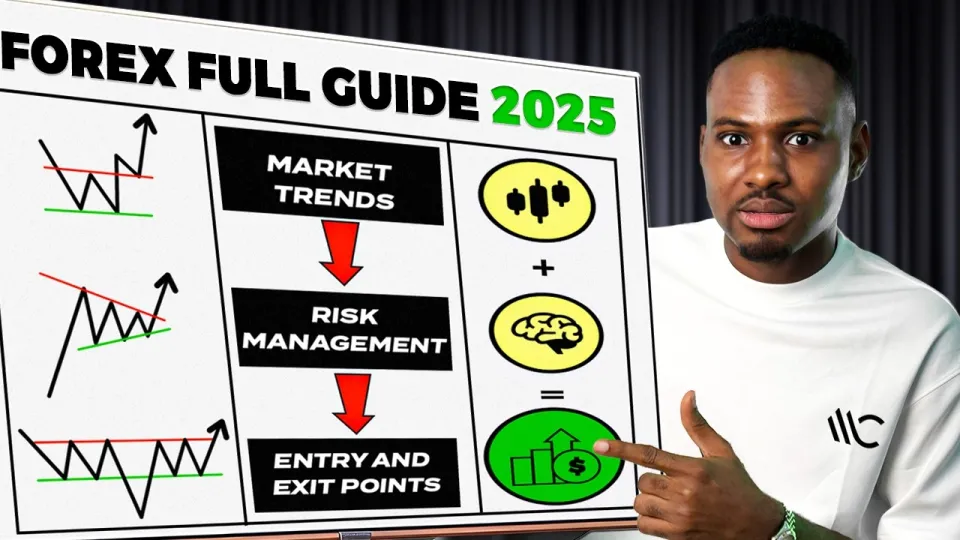
Video: How To Start Forex Trading For Beginners’ 2025 (Full Course)
You can order the same kind of articles for your own video to boost it on YouTube and Google. Just message the Telegram bot @sat_sit_bot. It writes articles around your video, embeds the video and publishes them on popular niche websites (no ads). Free trial — 50 articles.
· based on the channel Jeffrey Benson Forex
Forex for beginners is the process of learning how currency pairs are quoted and traded, choosing a regulated broker and platform, and practising one repeatable setup on a demo account with fixed risk before risking real money. You do not need a large balance or a finance degree to start; you need a written plan, a stop-loss on every trade and enough screen time to recognise how price behaves around the main sessions. A structured course such as the one published by Jeffrey Benson Forex is a useful map of that path, and the author's student programme is available at Fire Pips FX plans.
The sections below build the skill in order: what the market is, when it moves, which tools you actually need, how a basic setup is built, how a first trade is placed and which mistakes drain accounts fastest.
What forex trading actually is and how a currency pair is priced
Forex trading is the exchange of one currency for another at an agreed price, and every trade is a bet on the relative strength of two economies. Currencies are always quoted in pairs, for example EUR/USD, where the first currency is the base and the second is the quote: a price of 1.0850 means one euro buys 1.0850 US dollars. When you buy the pair you are long the base and short the quote; when you sell it you do the opposite.
Unlike stocks, there is no central exchange. Forex is an over-the-counter market where banks, funds, brokers and retail traders deal through a network of liquidity providers, which is why prices differ slightly between brokers and why spreads matter. Retail traders almost never take delivery of currency; positions are opened and closed for the price difference, and profits or losses are settled in the account currency.
Three terms explain most of the mechanics:
- Pip — the standard smallest price step, usually the fourth decimal (0.0001) for most pairs and the second decimal (0.01) for yen pairs.
- Lot — the trade size. One standard lot is 100,000 units of the base currency, a mini lot is 10,000, a micro lot is 1,000.
- Leverage and margin — leverage lets you control a larger position than your deposit; margin is the part of the balance the broker locks as collateral. Leverage magnifies both gains and losses.
How the forex market works across the four trading sessions
The forex market is open 24 hours a day from Sunday evening to Friday evening, and its behaviour changes with the session that is active. Liquidity and volatility cluster where trading desks overlap, which is why the same pair can sit still for hours and then move sharply within minutes.
- Sydney session opens the week and is the quietest, with tight ranges in AUD and NZD pairs.
- Tokyo session brings Asian flows and is often range-bound, though yen pairs can react to Japanese data.
- London session is the largest by turnover and usually sets the day's high and low for EUR/USD and GBP pairs.
- New York session adds US data releases and overlaps London for several hours — historically the most active window of the day.
A practical beginner routine follows that rhythm: study charts outside active hours, mark levels before London opens, and only look for entries when liquidity is present. Trading the dead hours between New York's close and Tokyo's open usually produces chop and unnecessary spread costs.
Tools you need before placing a single trade
A beginner's toolkit is small: a regulated broker, a charting platform, a position-size calculator and a journal. Everything else is optional until the basics are automatic.
- Broker. Check regulation, client-fund segregation, spreads and execution before funding anything. A broker offering MT5 and micro lots is enough to start; the author of the course points students to Assex Markets, where registration is open at https://my.assexmarkets.com/auth/register?partner_code=1699134.
- Platform. MetaTrader 5 (MT5) is the common choice for forex: charts, order types, indicators and a demo account. Link the broker account to the platform, then practise on demo first.
- Position-size calculator. Either built into the platform or a simple spreadsheet. It converts your risk in percent and your stop distance in pips into a lot size.
- Trading journal. Record date, pair, session, setup, entry, stop, target, result and one sentence on why you took the trade. Review it weekly.
- Economic calendar. Know when central-bank decisions, inflation prints and employment data land; spreads widen and slippage rises around them.
Building a basic forex strategy foundation
A basic forex strategy is a written set of conditions that tells you where to look, when to enter, where to place the stop and where to take profit — and it must be simple enough to execute the same way fifty times. Most beginner setups are built from three ingredients: market structure, a level and a trigger.
- Structure. Decide whether price is trending or ranging on the higher timeframe. In an uptrend you look for buys at support; in a range you fade the edges or stand aside.
- Level. Mark horizontal support and resistance, previous day's high and low, and round numbers. These are places where orders cluster.
- Trigger. Choose one confirmation, such as a bullish engulfing candle at support or a break and retest of a level, and refuse to trade without it.
Then fix the numbers in advance: risk per trade, stop distance, target multiple and the maximum number of trades per day. A common beginner template is a 1:2 risk-to-reward ratio, one setup per pair, no more than two trades a day and no trading during major news. The setup is not the hard part; repeating it without improvisation is.
Placing your first trade and sizing the position correctly
Placing a first trade is a mechanical sequence, and position sizing is the step that decides whether a bad week is survivable. Work through it in this order:
- Define the risk in money: 1% of a $1,000 account is $10.
- Measure the stop distance in pips from entry to invalidation — for example 20 pips.
- Calculate lot size so that 20 pips equals $10. With a micro lot, one pip is roughly $0.10, so 20 pips on 0.50 lots is about $10.
- Place a market or pending order, then immediately attach the stop-loss and take-profit.
- Log the trade in the journal and leave it alone until the stop or target is hit.
Risk of 1% means ten consecutive losses cost roughly 10% of the account — painful but recoverable. Risk of 10% per trade means the same streak nearly wipes the balance out. That single number, not the entry signal, separates traders who last from those who don't.
Common mistakes that empty beginner accounts
The most expensive beginner mistakes are behavioural, not analytical: they cost money long before a strategy is given a fair test. The pattern repeats across accounts and across brokers.
- No stop-loss or a stop moved wider mid-trade. A small loss becomes an account-threatening one.
- Oversized positions because the lot size was guessed rather than calculated from risk.
- Revenge trading after a loss, doubling size to win it back the same day.
- Strategy hopping — switching systems after three losing trades, so no setup is ever tested over a real sample.
- Skipping the demo phase and funding a live account before the routine is automatic.
- Ignoring the calendar and getting stopped out by a spread spike during a data release.
- No journal, which makes it impossible to tell whether the edge or the execution is the problem.
Questions beginners keep asking before they fund an account
Beginners usually want to know how much capital is realistic, how long the learning phase takes and whether copied signals can replace skill. A workable answer: start with money you can lose entirely, treat the first months as tuition, and use signals only as a study aid — copying trades without understanding the risk behind them transfers someone else's position size onto your balance. The free daily signal channel promoted with the course (https://t.me/firepipsignals) and the premium group at https://t.me/jeffreybenzhelpbot are best reviewed on a demo account first, so you can see how the entries behave before any real capital is exposed.
Useful links
- Student plans and course access: https://firepipsfx.com/plans
- Free daily signal channel: https://t.me/firepipsignals
- Broker registration used in the course: https://my.assexmarkets.com/auth/register?partner_code=1699134
- Premium signal group access: https://t.me/jeffreybenzhelpbot
Final takeaway
Forex rewards a boring, repeatable process: understand how pairs are quoted, trade when liquidity is present, use one setup with a written trigger, risk a fixed small percentage and write every trade down. The learning curve is measured in months of demo and small live trades, not in a single course, however well taught. The full beginner walkthrough from Jeffrey Benson Forex covers the same ground in video form and is a solid companion to this outline. If you want the structured route, start with the student plans at Fire Pips FX and keep the demo account open until the numbers in your journal justify going live.
Key takeaways
- Forex is an over-the-counter market where currencies are quoted in pairs; the first currency is the base, the second is the quote.
- The market runs 24 hours on weekdays across four sessions: Sydney, Tokyo, London and New York, with London-New York overlap the busiest window.
- A beginner needs three tools: a regulated broker, a charting platform such as MT5, and a written trading plan with fixed risk per trade.
- Risk of 1% per trade and a stop-loss on every position keep a losing streak survivable; 10 losses in a row cost about 10% of the account, not the account.
- Demo trading for at least 30-50 trades before going live is the cheapest way to test a setup and a routine.
Questions & answers
How much money do I need to start forex trading?
There is no fixed minimum, but the amount should be money you can lose without affecting your life. Many beginners start with a few hundred dollars on a micro-lot account so that 1% risk per trade stays a small, manageable sum. A larger balance is not a substitute for a tested setup; it only makes mistakes more expensive.
How long does it take to become consistently profitable?
Realistically, several months to a couple of years of deliberate practice, including a demo phase and a long stretch of small live trades with a journal. Progress depends on how many trades you review and whether you keep the same rules, not on how many videos you watch. Anyone promising consistent profits in weeks is skipping the part where risk is tested.
Can I copy signals instead of learning to trade myself?
Copying signals can show you how entries and exits are structured, but it does not teach you position sizing or how to react when a trade goes wrong. If you use a signal channel, run it on demo first and compare the results with your own journal. The risk on your account is still yours, whatever the source of the trade.
Is forex trading gambling?
Unplanned trading with oversized positions and no stop-loss behaves like gambling, because the outcome depends on luck rather than a defined edge. Trading with a written setup, fixed risk per trade and a recorded sample of results is a probability exercise you can evaluate and improve. The difference is the process, not the market.
Source: How To Start Forex Trading For Beginners’ 2025 (Full Course) · Markdown version